Executive Burnout Retreat Thailand.
When you are the one everyone relies on
You are used to being the person who holds it together. The one others rely on, the one with the answers, the one who finds a way through when there is no way. For a long time that capacity felt limitless. Lately it has not. Something has shifted, quietly at first and then impossible to ignore, and you have started to wonder whether the engine that carried you this far is finally running on empty.
You are not broken. You are depleted. And depletion, unlike failure, responds to the right kind of care. Holina Healing Centre is a residential retreat in the hills of Khao Yai, Thailand, two hours from Bangkok and a world away from the demands that brought you here. We work with people who have spent years performing at the edge of their capacity and have arrived at the point where the body and mind insist on being heard.
When high performance becomes the problem
There is a particular kind of exhaustion that does not come from doing too little. It comes from doing too much, for too long, at a level of intensity most people never sustain. High performance is not the opposite of burnout. Left unchecked, it is frequently the road to it.
Burnout vs stress in the body
Stress is a normal, time-limited response. Your nervous system rises to meet a demand, you handle it, and then your body returns to baseline. Burnout is what happens when that return never comes. Your nervous system has been living in a prolonged state of activation, and over time this changes how you sleep, digest, regulate mood, and think clearly. This is not weakness. It is a physiological state, and it can be addressed.
Why executives are uniquely vulnerable
Leadership carries a weight that is rarely visible from the outside. The decisions land on you, along with responsibility for other people. For many high performers the role and the self have merged so completely that slowing down feels like a threat to who they are. This combination of relentless responsibility and reluctance to step back is exactly what makes executives so often the last to seek support.
The hidden cost of pushing through
Pushing through works, right up until the moment it does not. The cost accumulates quietly. The relationships that have gone thin. The pleasures that have fallen away. The body that no longer recovers from a poor night sleep the way it used to. The growing sense that you are present everywhere and truly inhabiting nowhere.
The strange numbness
By the time many executives reach out, they describe a feeling that the achievements they worked so hard for no longer register. This is the hidden tax of sustained depletion. The good news is that this erosion is not permanent, and the work of restoration can begin the moment you decide to step out of the cycle.
Signs you are experiencing executive burnout
Burnout rarely arrives as a single, obvious symptom. It shows up across the whole of your life at once, which is part of why it is so easy to rationalise away. Seeing the pattern laid out can be the first step towards taking it seriously.
Physical
Chronic fatigue that sleep does not resolve. Broken or shallow sleep, or a mind that will not switch off. A run of minor illnesses. Headaches, tension in the jaw and shoulders, and digestion that has become unpredictable. Your body has been keeping the score.
Cognitive
Decision fatigue, where choices that once came easily now feel impossibly effortful. Brain fog that makes it hard to hold a thought or recall a name. A loss of the sharp focus you have always relied on, replaced by a scattered, reactive attention.
Emotional
A flattening of feeling, where things that should move you simply do not. Irritability that flares over small frictions. A creeping disconnection from the things that once gave your work meaning, and a cynicism towards pursuits that used to energise you.
Relational
Withdrawal from the people who matter. You come home with nothing left to give, so you give nothing. Conversations with family become logistical rather than warm. You pull back from your team, from friends, and most painfully from yourself.
Why executives need something built for them
Generic wellness does not work for people who lead. A spa week or a meditation app will not touch the depth of what sustained executive burnout does to the nervous system, and being asked to share your story in a circle of strangers is, for many in your position, simply not viable. You need an approach built around the realities of your life and the particular way you carry pressure.
- Total privacy, no requirement for group therapy. Your stay is confidential and your healing does not depend on disclosure. You can undertake your entire programme through private, individual sessions.
- Structured days, not open-ended relaxation. Your days have shape: a rhythm of therapeutic sessions, physical practices, rest, and reflection. The structure does the holding so that you do not have to.
- Clinical rigour alongside genuine restoration. Our work is grounded in established, evidence-informed approaches to the nervous system and to psychological recovery, delivered by experienced practitioners.
- A team who understands the weight of leadership. We work regularly with founders, executives, and high achievers. You will not have to explain the basics of your world before anyone can help you.

How Holina treats executive burnout
Recovery at Holina is not a single intervention but an integrated programme, shaped to your needs. Every element works towards the same aim: bringing an overdriven nervous system back into balance so that genuine restoration becomes possible.
Nervous system regulation as the foundation
Everything begins here. Before insight, before strategy, the nervous system needs to come out of its prolonged state of activation. We help your body relearn what safety and rest feel like, because a system stuck in survival mode cannot heal no matter how much it understands intellectually.
Individual psychotherapy
You will work one to one with an experienced therapist in private, confidential sessions. Drawing on cognitive behavioural and trauma-informed approaches, this work helps you examine the patterns that have driven you to this point, conducted at your pace.
Somatic therapy
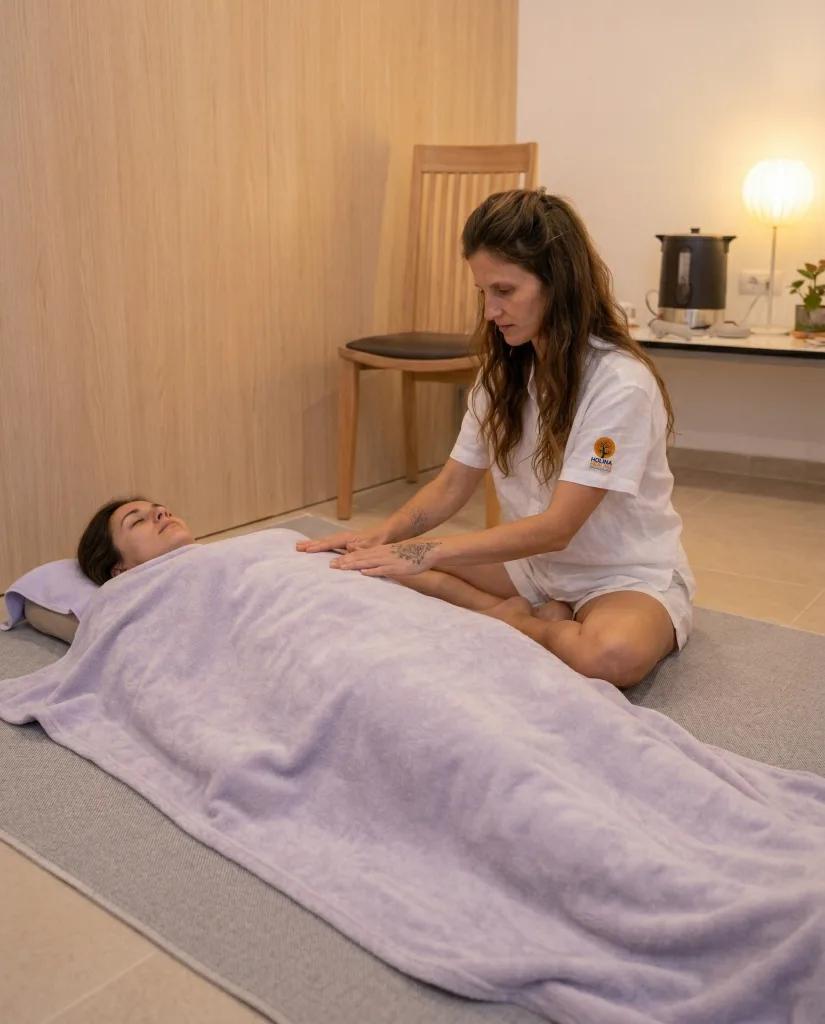
Sustained pressure lodges in the body long before the mind admits it. Somatic therapy works directly with this stored tension, helping you notice and release what years of pushing through have left held in your muscles, your breath, and your posture.
Sleep restoration and physical health reset
Burnout and broken sleep feed one another. A core part of your time here is dedicated to restoring genuine rest, supported by therapies such as IV vitamin therapy, hyperbaric oxygen therapy, therapeutic massage, and nourishing food.
Polyvagal work
Polyvagal therapy offers a clear, practical way of understanding why you feel the way you do, and a route back to calm. This work helps your system shift out of survival mode and into states of safety and connection, gently retraining the body to access rest.
Mindfulness and daily rhythm rebuilding
Recovery lives in the rhythm of the day. Through mindfulness, yoga therapy, movement, and a thoughtfully ordered structure, you rebuild a relationship with time that is not governed by urgency. These are tools you can carry home.
Where you recover matters as much as how
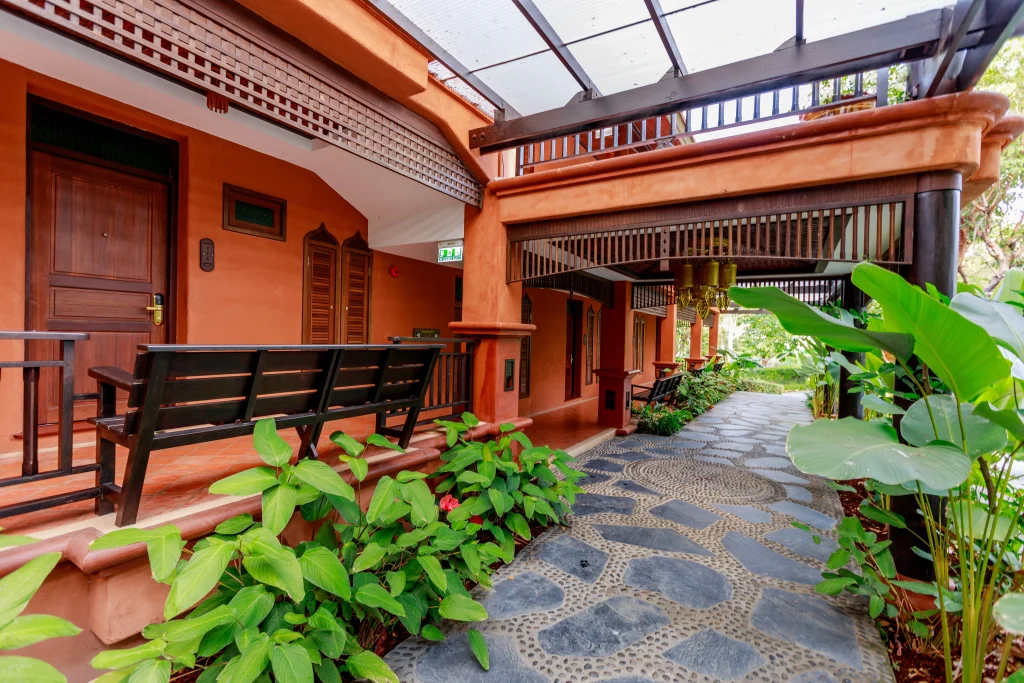
The environment at Holina is not a backdrop to the work. It is an active part of it, chosen and shaped to give an overloaded system the conditions it needs to settle.
- Khao Yai, two hours from the noise. Holina sits around 200 kilometres from Bangkok. Far enough to be genuinely removed from ordinary life, close enough to arrive without an arduous journey. For a nervous system that has forgotten how to stop, the quiet itself is part of the medicine.
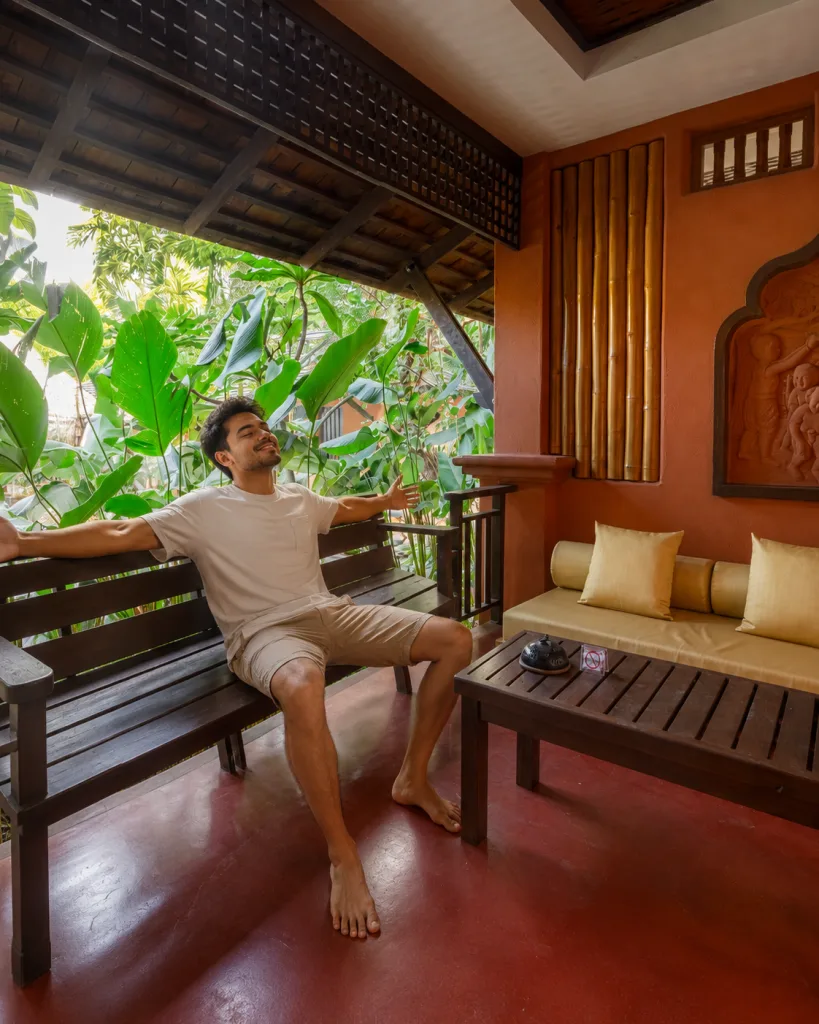
- Private accommodation, private sessions. Your space here is your own, somewhere to retreat, to rest, and to be entirely off duty. This is a place where you can let down the guard you have held in place for years.
- Nature immersion as active recovery. Walks, fresh air, the simple act of being among growing things. We treat time in nature as active recovery, supporting the deeper therapeutic work and helping your body remember a slower pace.
There is no single correct length for recovery
The right programme depends on how depleted you are, how much time you can protect, and what you hope to take home with you. We will help you choose, and the structure can flex as your needs become clearer.
Intensive reset
A focused fortnight designed to interrupt the cycle and create immediate relief. Enough to begin calming the nervous system, restore some genuine sleep, and leave with practical tools and a clearer sense of what comes next. A reset rather than a complete rebuild, and for many the doorway to deeper work later.
Full programme
Our recommended option for meaningful, lasting change. This gives the nervous system time to settle properly and allows the deeper psychological and somatic work to take root rather than simply begin. You leave with a changed relationship to the patterns that brought you here.
Transformation
For those ready to undertake the fullest possible change, the 90-day programme offers the time and depth genuine transformation requires. Three months allows for profound recovery, the embedding of new habits, and the kind of lasting shift that shorter stays can begin but rarely complete.
The people who find their way here
The people who find their way here are not weak and they are not failing. They are, more often than not, the people everyone else relies on. The following are anonymised portraits, drawn from the kinds of experiences we encounter, not real individuals. You may recognise something of yourself in them.
The founder post-exit with no identity left
They spent years building something, and then it sold, or it ended, and the structure that had organised their entire existence dissolved overnight. The question is who they are now that the thing that defined them is gone, and why the success they fought for feels so much like loss.
The executive who cannot feel anything
Outwardly they are functioning. They still deliver, still show up, still perform the role. But inside there is a flatness they cannot shake, a numbness where excitement and connection used to live. They want to know whether the capacity to feel can be recovered.
The high achiever whose body said no
For years they overrode every signal and treated the body as an inconvenience to be managed. Then it stopped cooperating, with collapse, with illness, with a fatigue that no willpower could override. They arrive often a little frightened, and ready, at last, to listen.
What people ask before they come
How long does burnout recovery take?
There is no single timeline, because recovery depends on how long you have been depleted and how deeply it has affected you. Some people feel a meaningful shift within a two-week reset, while genuine, lasting change usually takes longer, which is why we often recommend four to six weeks or more. We will talk honestly with you about what your situation is likely to need, and the programme can adapt as your recovery unfolds.
Will I be able to work during my stay?
The most powerful recovery comes from a genuine break, and we encourage you to step away as fully as you can, since constant connection keeps the nervous system in the very state we are trying to calm. That said, we understand the realities of leadership, and we can discuss sensible boundaries around limited contact where it is truly necessary.
Is my stay completely confidential?
Yes. Confidentiality is fundamental to everything we do. Your presence here, your sessions, and your story are protected, and your recovery never depends on disclosing anything to anyone you would not choose. Many of the people we work with are highly private for good reason, and we have built our entire approach around respecting that.
What is the difference between burnout and depression?
They can look similar and they can overlap, but they are not the same. Burnout is fundamentally a state of depletion arising from prolonged, unrelenting demand, closely tied to your circumstances and the chronic activation of your nervous system. As part of your time here, an experienced practitioner will help you understand what you are actually experiencing, so that your programme addresses the real picture rather than a label.
Do I need a referral to come?
No referral is required. Many people come to us through their own recognition that something has to change, while others are encouraged by a therapist, a doctor, or someone close to them. If you have been referred, we are glad to work alongside the people supporting you. If you have arrived here on your own, that is more than enough.
You have carried this for long enough. Step away and let the work begin.
A confidential enquiry is simply a quiet conversation, on your terms, with people who understand the weight you have been carrying. There is no pressure, and nothing you say commits you to anything. When you are ready, we are here.
Make a Private Enquiry