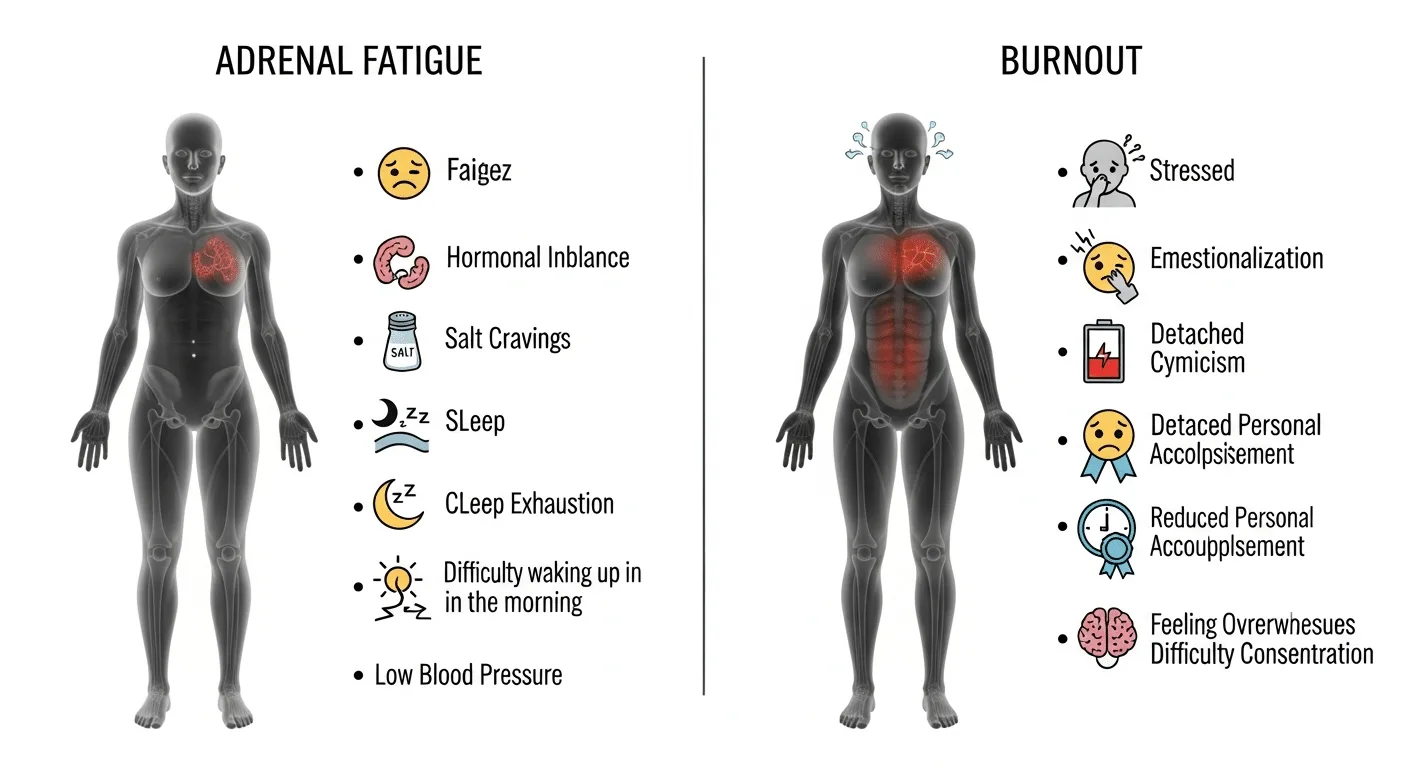
You’ve been running on empty for months — possibly years. The exhaustion isn’t the kind that resolves after a weekend away or an extra hour of sleep. It sits deeper than that: a bone-level depletion that affects your concentration, your emotional resilience, your capacity to feel motivated by things that once drove you. You’ve likely heard two terms used, sometimes interchangeably, to describe what you’re experiencing — adrenal fatigue and burnout. Understanding the adrenal fatigue burnout difference isn’t a matter of semantics. It has direct implications for how your condition should be assessed, monitored, and clinically addressed.
The confusion is understandable. Both conditions share a constellation of overlapping symptoms: persistent exhaustion, cognitive fog, disrupted sleep architecture, reduced stress tolerance, and a diminished sense of self. Both are more prevalent among high-functioning professionals who have sustained prolonged periods of psychological, physiological, or occupational pressure. And both are frequently dismissed or minimised within conventional medical consultations — often reducing patients to a result within the “normal” reference range on a standard blood panel, leaving them without answers and without a structured path forward.
But adrenal fatigue vs burnout represents a clinically meaningful distinction. One is rooted primarily in neuroendocrine dysregulation — specifically, dysregulation of the hypothalamic-pituitary-adrenal axis and cortisol secretion patterns. The other is classified by the World Health Organization as an occupational phenomenon with specific psychological and behavioural markers. In many patients, particularly those presenting with chronic, treatment-resistant exhaustion, the two conditions co-exist — which is precisely why accurate, physician-supervised assessment matters so profoundly before any integrated treatment protocol is initiated.
Two Diagnoses, One Overlapping Symptom Picture — and a Critical Distinction
Persistent exhaustion that sleep does not resolve. A flattened emotional range where things that once mattered now feel distant. Cognitive sluggishness that no amount of coffee corrects. These are the complaints that bring many high-functioning professionals through the doors of integrative medical clinics — and they are precisely the symptoms where adrenal fatigue and clinical burnout are most frequently, and most consequentially, confused.
The confusion is understandable. Both conditions share a surface presentation that looks, from the outside, like someone who is simply depleted. But the underlying physiology, the clinical trajectory, and — critically — the appropriate intervention differ in ways that matter enormously for recovery. Treating burnout as though it were a hormonal problem, or dismissing a genuine HPA-axis dysregulation as stress management failure, does not just delay recovery. In many cases, it actively entrenches the condition.
It is worth clarifying terminology immediately. Adrenal fatigue is not a diagnosis recognised in conventional endocrinology. The term was popularised in functional and integrative medicine circles to describe a spectrum of symptoms associated with dysregulation of the hypothalamic-pituitary-adrenal (HPA) axis — the neuroendocrine system governing cortisol production and the body’s physiological stress response. Legitimate clinical findings in this space include:
- Disrupted diurnal cortisol patterns on salivary or dried urine testing (DUTCH protocol)
- Blunted cortisol awakening response (CAR), a well-validated biomarker of HPA tone
- Dysregulated DHEA-S levels relative to cortisol output
- Altered autonomic nervous system balance measurable via heart rate variability (HRV)
Clinical burnout, by contrast, is formally classified by the World Health Organisation under ICD-11 as an occupational phenomenon — specifically, a syndrome resulting from chronic workplace stress that has not been successfully managed. Its three defining dimensions are emotional exhaustion, depersonalisation or cynicism toward one’s work, and a reduced sense of personal efficacy. Crucially, burnout is a psychosocial and neurological construct, not primarily a hormonal one — though, as the evidence increasingly shows, the two frequently co-occur, each amplifying the severity of the other.
Accurate differentiation begins with this understanding: one condition is rooted in measurable neuroendocrine dysregulation; the other in a documented neuropsychological response to chronic occupational demand. Both are real. Both are serious. And both require clinically structured assessment before any meaningful intervention can begin.
How Clinicians Actually Distinguish Between the Two — and Why the Difference Drives Treatment
The confusion between adrenal fatigue and clinical burnout is not simply semantic. It has direct consequences for how a condition is assessed, what laboratory work is ordered, and which interventions are likely to produce meaningful recovery versus prolonged stagnation. For patients who have spent years cycling through diagnoses without resolution, understanding this distinction is often the first clinically useful thing anyone has told them.
Clinical burnout is a formally recognised occupational phenomenon, classified by the World Health Organization in ICD-11 as a syndrome arising from chronic workplace stress that has not been successfully managed. It presents along three core dimensions: profound exhaustion that sleep does not resolve, psychological distancing or cynicism toward one’s professional responsibilities, and measurable reduction in cognitive efficacy. Critically, burnout is a neurological and psychological event as much as a physical one. Research using neuroimaging has shown structural and functional changes in the prefrontal cortex and amygdala in individuals with severe burnout — the same regions governing executive function, emotional regulation, and threat response.
The term adrenal fatigue, by contrast, is not an accepted medical diagnosis. It describes a hypothetical state in which chronic stress gradually depletes adrenal output, particularly cortisol, leaving patients exhausted, salt-craving, and unable to mount appropriate stress responses. While the concept resonates with patients because it fits their lived experience, standard serum and urinary cortisol testing rarely confirms the degree of adrenal insufficiency the framework implies. True adrenal insufficiency — Addison’s disease — is a serious endocrine condition with objective, measurable markers, and it is distinct from this broader concept.
What clinicians working in integrative medicine now recognise is a more nuanced picture: HPA axis dysregulation. This refers to disrupted signalling across the hypothalamic-pituitary-adrenal pathway — the body’s central stress-response network. Key indicators a physician-supervised evaluation should explore include:
- Diurnal cortisol rhythm assessed via four-point salivary or dried urine testing, rather than a single morning blood draw
- DHEA-S levels, which offer insight into adrenal reserve and often decline alongside cortisol dysregulation
- Inflammatory markers including high-sensitivity CRP and IL-6, which are frequently elevated in both burnout and HPA disruption
- Thyroid panel including free T3 and reverse T3, as thyroid function is frequently suppressed under chronic stress conditions
- Neurotransmitter precursor status — particularly serotonin, dopamine, and norepinephrine pathways — which burnout directly disrupts
- Sleep architecture assessment, since slow-wave sleep deficits both cause and perpetuate cortisol irregularity
The clinical picture that emerges from this comprehensive evaluation frequently shows that a patient’s exhaustion is not one thing. It is layered — part autonomic, part hormonal, part neurological — and no single-axis treatment adequately addresses all of it. This is precisely why evidence-based, integrated protocols that assess the whole system simultaneously tend to produce outcomes that fragmented, single-discipline approaches do not.
Why Accurate Diagnosis Changes Everything About Treatment
The distinction between adrenal fatigue as a popular construct and clinically documented burnout or HPA-axis dysregulation is not merely academic. It has direct, measurable consequences for how you are assessed, what interventions are selected, and whether you actually recover. Pursuing the wrong framework — whether over-medicalising exhaustion or dismissing it as stress — can extend suffering by months or years.
A rigorous diagnostic workup should always begin by ruling out primary adrenal insufficiency (Addison’s disease) and secondary causes through morning serum cortisol, ACTH stimulation testing, and a comprehensive metabolic panel. Thyroid function, sex hormone levels, fasting glucose, and inflammatory markers including CRP and IL-6 provide a biochemical baseline that no symptom checklist can replace. This is not optional precision — it is the foundation of responsible care.
Once organic pathology is excluded or addressed, the clinical picture of burnout — characterised by chronic stress-induced HPA-axis dysregulation, autonomic nervous system imbalance, and neuroinflammatory changes — requires a genuinely integrated response. Evidence-based interventions that have demonstrated measurable outcomes include:
- Structured sleep restoration protocols targeting circadian rhythm correction, since cortisol awakening response abnormalities are measurable and reversible with consistent intervention
- Physician-supervised nutritional support addressing micronutrient insufficiencies — particularly magnesium, B vitamins, and vitamin D — that directly affect mitochondrial function and neurotransmitter synthesis
- Somatic and trauma-informed therapies such as and somatic experiencing, which have demonstrated efficacy in regulating the autonomic nervous system when cognitive approaches alone have been insufficient
- Graduated physical reconditioning calibrated to individual HRV and recovery data, avoiding the common clinical error of prescribing high-intensity exercise to a dysregulated nervous system
- Psychotherapeutic frameworks addressing the cognitive and identity-level dimensions of burnout, particularly in high-performing individuals whose sense of self is deeply entangled with productivity
At Holina Healing, every assessment is conducted by physicians and structured around what your biochemistry, history, and functional capacity actually indicate — not what a category label suggests. The goal is not to validate a diagnosis but to identify what is genuinely driving your symptoms and apply clinically validated protocols with sufficient depth and duration to produce lasting physiological change. That level of precision, delivered within a physician-supervised residential environment, is what separates meaningful recovery from temporary relief.
The distinction between adrenal fatigue and clinical burnout is not semantic — it is clinically consequential. Pursuing the wrong framework means pursuing the wrong intervention, and for high-functioning individuals already carrying years of accumulated physiological debt, that misdirection has a real cost. One condition responds to neuroendocrine recalibration and targeted nutritional support; the other demands structured nervous system rehabilitation, psychological processing, and measurable cortisol rhythm restoration. In many cases, both are operating simultaneously, compounding each other in ways that no single-discipline approach can adequately address.
What these conditions share is this: they do not resolve through willpower, vacation, or generic supplementation. They require precise clinical assessment, physician-supervised protocols, and an integrated strategy that accounts for the full biological and psychological picture — not a checklist of symptoms, but a person.
At Holina Healing in Khao Yai, Thailand, our medical team works with internationally referred patients to deliver exactly that level of rigor. If you have been told your results are normal but your body tells a different story, we invite you to begin a proper clinical conversation with us.