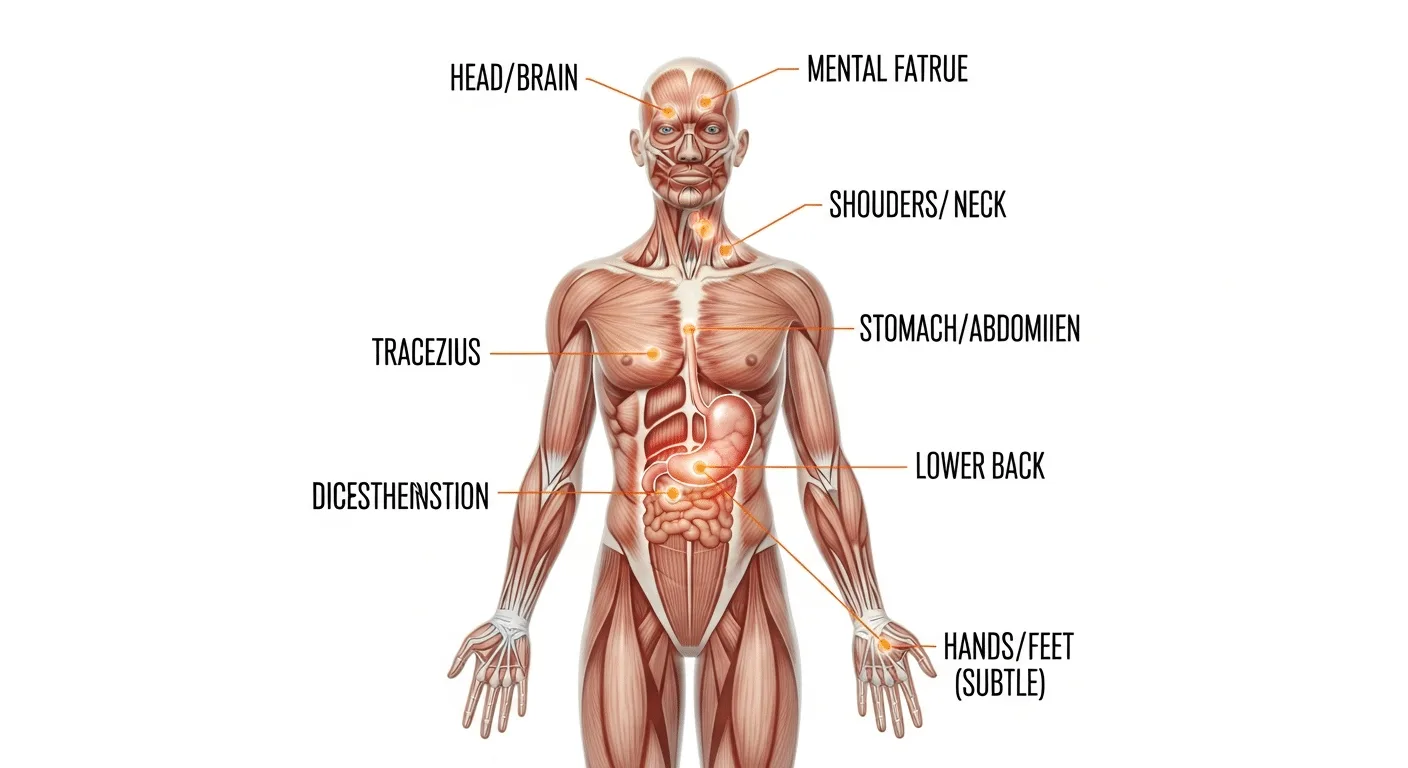
Most people think burnout is a mental health problem. It isn’t — or at least, it isn’t only that. By the time exhaustion has reached your body, registering as chest tightness that cardiology can’t explain, as infections that won’t resolve, as a fatigue that eight hours of sleep does nothing to touch, the nervous system has already been operating in a state of chronic dysregulation for months, sometimes years. The physical symptoms of burnout are not a side effect. They are a biological signal that the body has exceeded its adaptive capacity.
What makes burnout physical health consequences so clinically significant — and so consistently underestimated — is the delay. Psychological depletion almost always precedes the somatic collapse, which means that by the time body signs of burnout become impossible to ignore, the underlying physiological damage is neither new nor superficial. Cortisol dysregulation, mitochondrial dysfunction, disrupted immune signalling, and autonomic nervous system imbalance do not develop overnight, and they do not resolve with a long weekend.
This matters because treatment that addresses only the mind, while ignoring what has happened to the body at a cellular and systemic level, is incomplete medicine. Physician-supervised, integrated approaches that assess the full biological picture — not just mood and sleep, but inflammatory markers, hormonal patterns, and nervous system function — are not optional for true recovery. They are the clinical standard burnout deserves.
Burnout Is a Physiological Event, Not a State of Mind
Most people arrive at a burnout diagnosis after months — sometimes years — of dismissing what their body has already been trying to communicate. The persistent headaches attributed to screen time. The 3 a.m. waking that gets blamed on stress. The recurring infections that seem to have no explanation. These are not incidental complaints sitting alongside burnout. They are burnout — expressed through the only language the body has available to it when cognitive and emotional coping mechanisms have been fully exhausted.
This distinction matters clinically. Burnout is now classified by the World Health Organization in the ICD-11 as an occupational phenomenon with measurable physiological consequences, not simply a psychological state requiring rest and perspective. Research published in Psychoneuroendocrinology has consistently demonstrated that chronic occupational stress drives dysregulation of the hypothalamic-pituitary-adrenal (HPA) axis — the central command system governing your cortisol response. When the HPA axis is disrupted over extended periods, the downstream effects are systemic and measurable.
What does that look like in practice? Cortisol, which should follow a clear diurnal rhythm — highest in the morning, tapering through the day — becomes flattened or erratic. The immune system, which depends on appropriate cortisol signaling for proper regulation, begins to malfunction. Inflammatory markers rise. Gut permeability increases. Mitochondrial function in cells declines. Sleep architecture deteriorates at the level of slow-wave and REM cycles, not merely duration. These are not metaphors for feeling exhausted. They are documented biological events.
Physical symptoms in late-stage burnout commonly include:
- Disproportionate fatigue that does not resolve with sleep or days off
- Cardiovascular irregularities including elevated resting heart rate and blood pressure variability
- Gastrointestinal dysfunction — bloating, motility changes, IBS-pattern symptoms
- Hormonal disruption, particularly in thyroid and sex hormone axes
- Cognitive impairment including working memory deficits and processing speed reduction
- Immune dysregulation presenting as frequent illness or slow recovery
- Musculoskeletal pain, particularly in the neck, shoulders, and jaw
Understanding these symptoms as a coherent biological pattern — rather than isolated complaints to be treated separately — is the foundation of any clinically meaningful recovery. When physical symptoms appear, the nervous system is not sending an early warning. It is sending a final one.
The Physiology of Burnout: What Is Actually Happening Inside Your Body
Burnout is not a mindset problem. It is a measurable physiological state with identifiable biomarkers, disrupted organ function, and cumulative cellular damage. Understanding this distinction is clinically important — because it changes both how the condition is assessed and how it must be addressed.
At the center of burnout pathophysiology is the hypothalamic-pituitary-adrenal (HPA) axis, the body’s primary stress-response system. Under sustained psychological and occupational pressure, the HPA axis becomes dysregulated. In early-stage burnout, cortisol output is typically elevated — driving insomnia, irritability, and the hypervigilant exhaustion that many high-functioning professionals recognize as their baseline. Over time, however, the system inverts. Prolonged HPA activation leads to adrenal fatigue patterns and blunted cortisol curves: flat morning levels, absent stress-response peaks, and the profound, unrestorative fatigue that no amount of sleep appears to resolve.
Concurrently, chronic stress exposure activates the sympathetic nervous system at the expense of parasympathetic recovery. Heart rate variability (HRV) — a validated clinical marker of autonomic nervous system resilience — decreases measurably in individuals with burnout. Low HRV is independently associated with increased cardiovascular risk, impaired immune regulation, and reduced cognitive performance. This is not metaphor. These are quantifiable changes visible in laboratory and biometric data.
Systemic inflammation is another consistent finding. Elevated pro-inflammatory cytokines, including interleukin-6 (IL-6) and C-reactive protein (CRP), have been documented in burnout populations. This inflammatory burden has downstream consequences across multiple systems:
- Gut microbiome disruption and increased intestinal permeability, contributing to digestive symptoms and nutrient malabsorption
- Thyroid function suppression, compounding fatigue and metabolic slowdown
- Blood glucose dysregulation, even in individuals without pre-existing metabolic conditions
- Immune suppression, reflected in increased susceptibility to infection and prolonged recovery times
- Neuroinflammation, which directly impairs prefrontal cortex function — affecting decision-making, emotional regulation, and working memory
This is why physician-supervised assessment matters. A clinically integrated evaluation — incorporating cortisol mapping, inflammatory markers, autonomic function testing, and metabolic panels — provides a biological baseline that psychological assessment alone cannot capture. Physical symptoms in burnout are not secondary complaints. They are the body’s accumulated evidence of a system operating beyond its sustainable limits.
Rebuilding From the Body Up: What Effective Burnout Recovery Actually Requires
By the time burnout has written itself into your physiology — disrupted cortisol rhythms, impaired autonomic function, systemic inflammation — recovering from it requires more than a change in schedule or a few weeks of rest. The body has adapted, often over years, to a state of sustained threat. Reversing those adaptations demands a structured, physician-supervised approach that addresses the underlying biological dysregulation, not just its surface expressions.
Effective recovery at this level typically involves several interconnected clinical priorities:
- Comprehensive physiological assessment: Functional laboratory work — including cortisol curve mapping, thyroid panel, inflammatory markers, micronutrient status, and autonomic nervous system evaluation — provides the diagnostic foundation that most standard check-ups never reach. You cannot address what you have not measured.
- HPA axis stabilisation: Targeted nutritional and pharmacological support, where clinically indicated, to restore the adrenal rhythm that governs energy, immune response, and mood regulation. This is not supplementation as guesswork; it is precision intervention based on individual biomarker data.
- Nervous system recalibration: Evidence-based somatic therapies — including neurofeedback, heart rate variability training, and breathwork protocols derived from polyvagal research — directly engage the autonomic dysregulation that no amount of cognitive reframing will resolve on its own.
- Sleep architecture restoration: Clinically supervised sleep intervention that addresses the specific mechanisms disrupting restorative stages, whether cortisol-driven early waking, suppressed slow-wave sleep, or HRV-confirmed sympathetic dominance through the night.
- Integrated psychological support: Where trauma underlies the burnout pattern — and it frequently does — body-oriented therapeutic modalities such as or somatic experiencing address the neurological imprint that perpetuates the stress response long after the original pressure has lifted.
The physical symptoms you have been managing, dismissing, or medicating one by one are a coherent signal. They are your nervous system communicating, with increasing urgency, that the current equilibrium is not sustainable. Treating them as a system — rather than a list of separate complaints — is what distinguishes genuine recovery from temporary relief.
At Holina Healing, the clinical team works with each individual through an integrated, evidence-based protocol designed around their specific physiological and psychological profile. The work is rigorous, structured, and grounded in current research on stress biology and neurological recovery. For people who have already exhausted conventional approaches, that specificity is not a luxury. It is the point.
Burnout does not announce itself politely. By the time the body speaks — through disrupted sleep, persistent inflammation, hormonal dysregulation, and immune dysfunction — the nervous system has already been operating in crisis mode for months, sometimes years. These physical symptoms are not incidental. They are the accumulated evidence of a system that has been asked to do too much, for too long, without adequate recovery.
Recognising this moment as a clinical turning point, not a personal failure, is where meaningful recovery begins. The path forward requires more than rest. It requires a structured, physician-supervised process that addresses the underlying physiological and psychological drivers simultaneously — not one at a time.
At Holina Healing in Khao Yai, Thailand, our integrated, evidence-based programmes are designed for individuals who understand the complexity of what they are facing and are ready for a clinically rigorous approach to recovery. If your body has been signalling that something is wrong, it is worth taking that seriously. Reach out to our team to begin a confidential conversation.