Burnout does not arrive overnight. It builds in layers — quietly dismantling your capacity for focus, connection, and recovery until one morning you realise that pushing harder simply produces less. If you have found yourself wondering whether what you are experiencing is genuine burnout or ordinary fatigue, the distinction matters clinically, and it matters for what comes next.
Research published in occupational health medicine has moved well beyond the binary of “stressed” versus “burned out.” There is now a clinically recognised progression — a staged deterioration that follows predictable patterns across neurobiology, hormonal function, and psychological resilience. Understanding where you sit within that progression is not an exercise in self-diagnosis. It is the first step toward targeted, physician-supervised intervention that addresses the actual mechanisms driving your symptoms, not just their surface presentation.
The stages of burnout severity range from early-warning dysfunction — disrupted sleep, creeping cynicism, reduced output despite longer hours — through to full physiological collapse, where the HPA axis, immune regulation, and cognitive function are all measurably compromised. Most people seeking help are somewhere in the middle, having normalised a level of depletion that would concern any clinician who examined them properly.
What follows is an evidence-based framework to help you assess how far along this continuum you genuinely are — and understand what meaningful, integrated recovery looks like at each stage.
Burnout Is Not a Mood — It’s a Measurable Physiological Cascade
Most people arrive at the word “burnout” long after the process has already been underway for months, sometimes years. What presents as exhaustion or disengagement is, in clinical terms, the visible surface of a much deeper biological unraveling — one that progresses through identifiable stages, each with its own neurological, hormonal, and immunological fingerprint. Understanding where you are in that progression is not an exercise in self-diagnosis. It is a prerequisite for choosing an intervention that matches the actual severity of what your body and nervous system are experiencing.
The foundational research comes from psychologists Herbert Freudenberger and Gail North, whose 12-phase burnout model was later refined by occupational medicine researchers and validated through cortisol mapping, HPA axis studies, and inflammatory biomarker analysis. What the science consistently shows is that burnout is not a psychological weakness or a failure of resilience. It is a dysregulation of the body’s stress-response architecture — specifically the hypothalamic-pituitary-adrenal (HPA) axis — that, left unaddressed, produces measurable changes in brain structure, immune function, and cardiovascular health.
For high-functioning professionals, the danger is compounded by a particular cognitive trap: competence becomes a mask. The executive who is still closing deals, the physician still seeing patients, the founder still on calls at midnight — these individuals are often functioning at Stage 4 or Stage 5 of burnout while their external performance metrics suggest nothing is wrong. The body, however, is keeping an entirely different ledger.
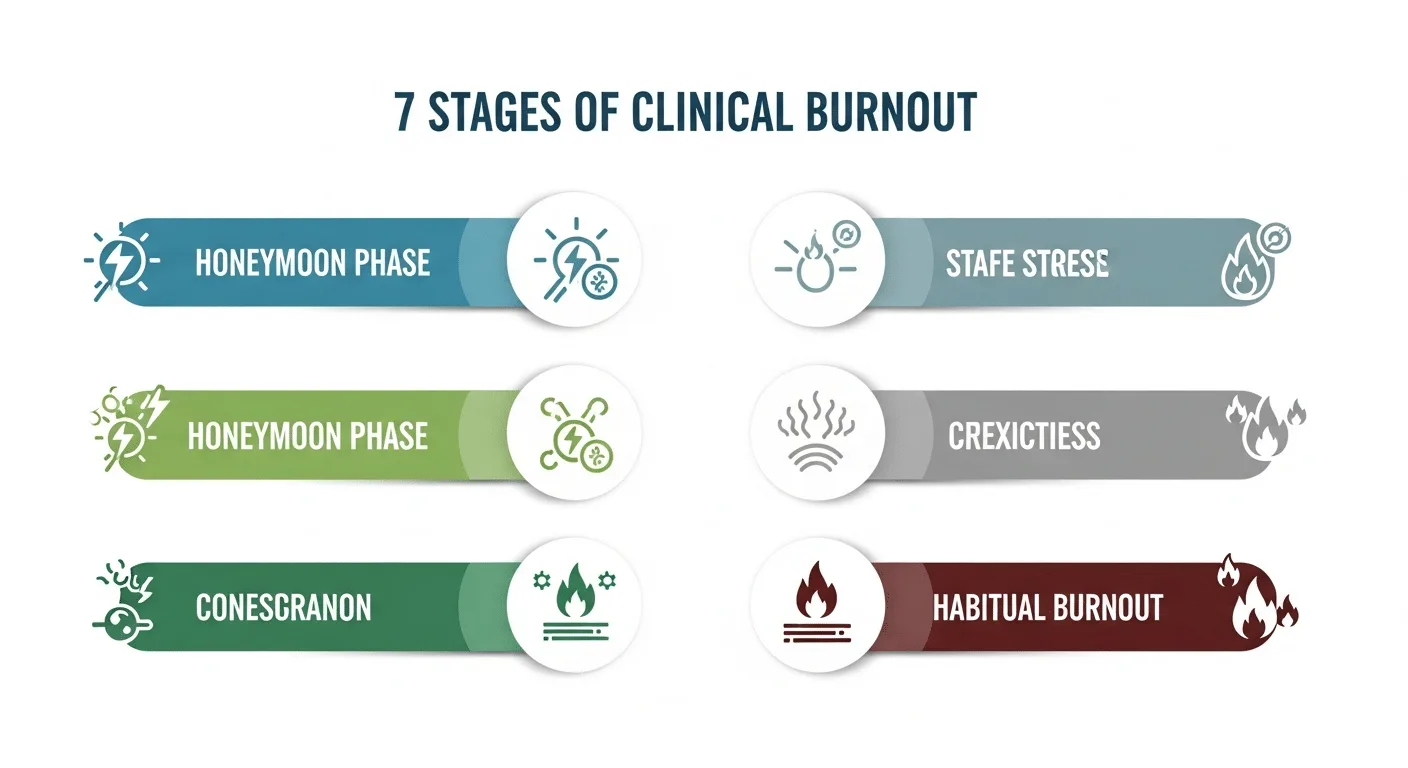
Clinically, burnout progression can be mapped across seven discrete stages, each representing a shift in the relationship between the sympathetic nervous system, cortisol regulation, and the brain’s prefrontal capacity for executive function. These stages are not arbitrary categories. They correspond to measurable changes that physician-supervised assessment can identify through tools including salivary cortisol panels, heart rate variability analysis, inflammatory markers such as IL-6 and CRP, and validated psychological inventories including the Maslach Burnout Inventory.
The earlier the stage is identified, the broader the range of clinically validated interventions available. By Stage 6 or 7, recovery requires a fundamentally different — and far more intensive — level of integrated medical support.
Stages 3–5: When the Body Starts Keeping Score
By the time burnout reaches its intermediate stages, the nervous system has shifted from a state of chronic activation into something more complex — a dysregulated pattern where the body can no longer reliably distinguish between threat and safety. What began as overcommitment in Stage 1 and compensatory pushing in Stage 2 now becomes physiological. This is where many high-functioning professionals finally seek help, often because their body has forced the issue when their willpower could not.
Stage 3: Chronic Fatigue and Sleep Disruption. Sleep stops being restorative. You may fall asleep without difficulty but wake at 3 a.m. with a racing mind, or find yourself exhausted despite eight hours in bed. Cortisol dysregulation — specifically the flattening of the diurnal cortisol curve — is a measurable neuroendocrine change at this stage. Clinically, we see elevated evening cortisol paired with blunted morning awakening response. The result is a body that is tired but wired, unable to complete the recovery cycle it desperately needs.
Stage 4: Physical Symptom Onset. Headaches, gastrointestinal complaints, recurring infections, and musculoskeletal tension are not incidental at this stage — they are the body’s inflammatory signalling system responding to sustained allostatic load. Research published in Psychosomatic Medicine links prolonged occupational stress to measurable increases in pro-inflammatory cytokines, including IL-6 and TNF-α. Immune suppression is not metaphorical; it is biochemical.
Stage 5: Emotional Blunting and Detachment. This stage is frequently misidentified as depression, and while the two conditions share neurological overlap, they are clinically distinct. Burnout at Stage 5 produces a specific anhedonia — not sadness, but a flat absence of engagement. Relationships feel transactional. Work that once carried meaning feels hollow. Neurologically, this corresponds to reduced activity in the medial prefrontal cortex and altered dopaminergic signalling in the reward pathways.
Stages 3 through 5 represent the critical intervention window. With physician-supervised assessment and an integrated approach addressing neuroendocrine function, inflammation, and autonomic regulation, meaningful recovery is not only possible — it is the expected clinical outcome when addressed systematically rather than symptom by symptom.
- Key indicators you are in this range: unrefreshing sleep persisting beyond four weeks; two or more new physical complaints with no identified structural cause; withdrawal from relationships or activities that previously held genuine value
- What conventional medicine often misses: treating the presenting symptom — the headache, the insomnia, the low mood — in isolation, without investigating the neuroendocrine and autonomic architecture driving all three simultaneously
- Evidence-based markers worth investigating: salivary cortisol curve, high-sensitivity CRP, fasting insulin, HRV baseline, and thyroid panel including free T3, which is frequently suppressed under conditions of chronic physiological stress
Stages 5–7: When the Body Takes Over — and What Clinical Recovery Actually Requires
By Stage 5, burnout has moved beyond psychology. Chronic fatigue that doesn’t resolve with sleep, recurring infections, hormonal dysregulation, cardiovascular irregularities, and gut dysfunction are now the dominant presentation. The HPA (hypothalamic-pituitary-adrenal) axis — your body’s central stress-response system — has been operating in sustained overdrive and is now dysregulated. Cortisol curves flatten. Inflammatory markers rise. This is no longer a motivation problem or a mindset issue. It is a physiological state that requires clinical assessment, not a long weekend away.
Stage 6 brings what researchers classify as depersonalisation and existential exhaustion. High-functioning individuals at this stage often describe feeling like observers of their own lives — emotionally blunted, disconnected from people they love, unable to locate any sense of meaning or identity beyond performance. Many present with anhedonia, intrusive rumination, and disrupted sleep architecture. Standard antidepressant protocols frequently prove insufficient here because the underlying neuroendocrine and autonomic dysfunction remains unaddressed.
Stage 7 — total collapse — can manifest as complete functional breakdown: inability to work, severe somatic illness, psychiatric crisis, or all three simultaneously. This is the stage that forces the question that should have been asked much earlier. The good news, supported by clinical evidence, is that even at this stage, structured recovery is achievable — but it demands an integrated, physician-supervised approach that goes far beyond conventional outpatient therapy.
Clinically grounded recovery at Stages 5 through 7 typically involves:
- Comprehensive biomarker assessment — cortisol rhythm testing, inflammatory panels, thyroid and sex hormone evaluation, micronutrient analysis, and autonomic nervous system mapping
- Nervous system regulation protocols — including heart rate variability training, neurofeedback, and somatic therapies with demonstrated efficacy in trauma and chronic stress literature
- Nutritional and mitochondrial support — IV micronutrient therapy and targeted supplementation based on individual deficiency profiles, not generic wellness formulas
- Trauma-informed psychotherapy — specifically or Internal Family Systems, both of which carry strong evidence bases for burnout complicated by developmental or occupational trauma
- Sleep architecture restoration — physician-supervised intervention addressing the neurological and hormonal drivers of disrupted sleep, not symptom suppression alone
- Structured reintegration planning — because recovery without a supervised return-to-function protocol frequently results in relapse within six to twelve months
Recognising your stage is the first clinically meaningful step. The mechanism of burnout is well understood; the error most high-achievers make is waiting until Stage 6 or 7 before treating it with the seriousness it warrants. If the patterns described across any of these seven stages feel familiar, that recognition carries significant clinical weight — and it is worth acting on it now, with the appropriate level of professional support.
Burnout does not resolve through willpower, a long weekend, or a change in schedule. It is a physiological and neurological process — one that progresses through distinct, measurable stages, each demanding a more structured and clinically informed response than the last. Left unaddressed, what begins as persistent fatigue can evolve into autonomic dysregulation, immune compromise, and cognitive impairment that standard outpatient care is rarely equipped to reverse.
Recognising where you are on this spectrum is not a defeat. It is the most clinically relevant decision you can make. The earlier the intervention, the less ground there is to recover — but even advanced-stage burnout responds to the right combination of physician-supervised diagnostics, nervous system stabilisation, nutritional medicine, and evidence-based psychotherapeutic protocols.
At Holina Healing in Khao Yai, Thailand, our integrated medical team works with high-functioning individuals whose lives no longer reflect their capacity. If you recognise yourself in these stages, we invite you to begin with a confidential clinical consultation — and build a recovery protocol grounded in evidence, not guesswork.