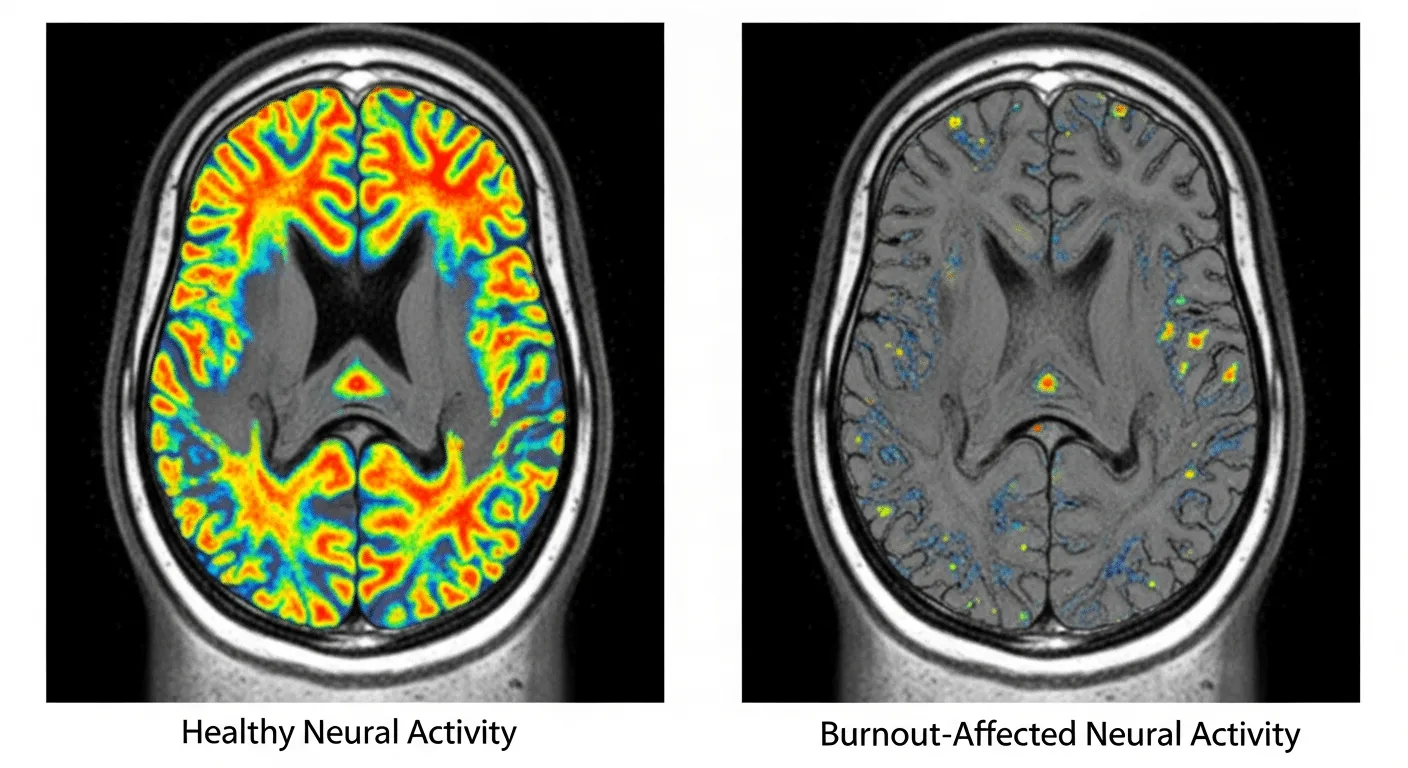
Burnout is not a mindset problem. It is not a scheduling failure, a productivity gap, or evidence that you need to push harder. When we examine the neuroscience of burnout, what emerges is a picture of measurable, physiological change — structural and functional alterations in the very architecture of your brain that explain why willpower alone will never be enough to pull you out of it.
The burnout brain is a brain under chronic siege. Prolonged occupational and emotional stress floods neural tissue with cortisol and adrenaline at levels the human nervous system was never designed to sustain over months or years. The prefrontal cortex — your seat of decision-making, emotional regulation, and executive function — begins to thin. The amygdala, responsible for threat detection and fear response, becomes hyperactive and hypersensitive. The hippocampus, critical for memory consolidation and stress modulation, shows measurable volume reduction in neuroimaging studies of individuals with chronic stress exposure. These are not metaphors. They are changes visible on MRI scans.
Understanding what happens to your brain during burnout reframes the entire recovery conversation. If the damage is neurological, the intervention must be too. This is precisely why evidence-based, physician-supervised programs that address nervous system dysregulation at a biological level — not just behavioral coaching or talking through work stress — represent the only genuinely comprehensive path toward meaningful restoration of cognitive and emotional function.
The Neuroscience of Burnout: What’s Actually Happening Inside Your Brain
Burnout is not a productivity problem, a motivation deficit, or a sign that you need a long weekend. It is a measurable neurobiological state — one that alters the structure and function of your brain in ways that standard rest, willpower, or a change of scenery cannot reverse. Understanding what is happening at a physiological level is the first step toward addressing it with the seriousness it deserves.
At the centre of the burnout brain is a chronically dysregulated stress response. When the body perceives sustained threat — whether from relentless professional pressure, unresolved trauma, or accumulated life demands — the hypothalamic-pituitary-adrenal (HPA) axis remains in a state of prolonged activation. Cortisol, your primary stress hormone, floods the system not in short adaptive bursts, but continuously. Over months and years, this sustained cortisol exposure becomes toxic to brain tissue itself.
Research published in peer-reviewed journals including NeuroImage and Psychoneuroendocrinology has demonstrated that individuals with clinical burnout show measurable changes in three key brain regions:
- The prefrontal cortex — responsible for executive function, rational decision-making, and emotional regulation — shows reduced grey matter volume and impaired connectivity. This explains the cognitive fog, poor judgement, and emotional reactivity that high-functioning people find so disorienting.
- The amygdala — the brain’s threat-detection centre — becomes hyperactivated and structurally enlarged, generating disproportionate fear and anxiety responses to ordinary stressors.
- The hippocampus — critical for memory consolidation and stress regulation — shrinks under prolonged cortisol exposure, contributing to both memory disruption and a reduced capacity to modulate the stress response itself.
This creates a self-reinforcing cycle. The very brain structures needed to manage stress become compromised by stress. Willpower and cognitive reframing strategies lose their effectiveness not because the person is weak, but because the neurological substrate supporting those capacities has been structurally and functionally impaired.
What you are experiencing is not a character flaw. It is a measurable change in brain architecture — and it requires an integrated, clinically grounded response that matches the depth of the problem.
The Neuroscience of Burnout: What Brain Imaging and Biomarkers Actually Show
Burnout is not a productivity problem or a failure of resilience. Neuroimaging studies and biomarker research have made this unambiguous: chronic occupational and emotional stress produces measurable, structural changes in the brain. Understanding these changes is the foundation of any clinically sound recovery approach.
One of the most consistently documented findings involves the prefrontal cortex — the region responsible for executive function, emotional regulation, and rational decision-making. Under prolonged stress, grey matter volume in this area demonstrably reduces. The result is not vague cognitive fog; it is a specific, observable impairment in your capacity to prioritise, regulate emotional responses, and think with clarity. Patients often describe this as feeling “like a different person.” Neurologically, there is something precise to that perception.
Simultaneously, the amygdala — the brain’s primary threat-detection centre — becomes hyperreactive. Functional MRI research shows that in individuals with chronic stress and burnout, amygdala activation increases while connectivity between the amygdala and prefrontal cortex weakens. This disrupted communication is clinically significant: it means the brain’s alarm system is operating at elevated sensitivity while the structures that would ordinarily modulate that alarm are compromised. Heightened anxiety, emotional reactivity, and disproportionate stress responses are the predictable outcome of this neurological pattern — not character flaws.
The hypothalamic-pituitary-adrenal (HPA) axis undergoes dysregulation as well. Cortisol, the primary stress hormone, follows an abnormal diurnal pattern in burnout patients — often presenting as blunted morning cortisol response, elevated evening levels, or a flattened curve across the day. This is measurable through salivary cortisol testing and has downstream consequences including:
- Disrupted sleep architecture and non-restorative sleep
- Impaired immune regulation and increased inflammatory markers (notably elevated IL-6 and CRP)
- Suppressed neurogenesis in the hippocampus, affecting memory consolidation and emotional processing
- Metabolic dysregulation, including altered glucose metabolism and increased cortisol-driven fat retention
The hippocampus itself warrants particular attention. This structure is central to memory formation and stress context — and research from the Max Planck Institute and others has documented hippocampal volume reduction in individuals with prolonged burnout and stress exposure. This is the same pattern observed in clinical depression and PTSD, which is why many burnout patients find that standard talk therapy, designed for insight rather than neurological restoration, produces limited results at this stage of depletion.
What this body of evidence establishes clearly is that recovery from advanced burnout requires more than rest or cognitive reframing. It requires a physician-supervised, integrated approach that addresses the neurobiological substrate of the condition — including HPA axis recalibration, inflammatory load reduction, and support for neuroplasticity through clinically validated protocols.
Clinical Pathways Out of Burnout: What Evidence-Based Recovery Actually Looks Like
Recovery from burnout is not a matter of rest alone. Because the changes occurring in the brain are structural and neurochemical — not simply the result of a bad week or an overloaded inbox — meaningful recovery requires a clinically structured, physician-supervised approach that addresses the underlying neurobiology rather than masking its symptoms.
The most rigorously supported interventions work across several interconnected mechanisms simultaneously. Effective protocols target HPA axis dysregulation, restore disrupted sleep architecture, rebuild prefrontal cortical function, and address the chronic inflammatory burden that sustains the cycle. No single modality achieves this in isolation.
An integrated recovery framework typically includes the following evidence-based components:
- Nervous system regulation therapies: Modalities such as neurofeedback, Heart Rate Variability (HRV) biofeedback, and somatic-based interventions have demonstrated measurable impact on autonomic dysregulation — the persistent fight-or-flight state that characterises advanced burnout. These are not relaxation techniques; they are clinically validated tools for recalibrating the sympathetic-parasympathetic balance.
- Nutritional and metabolic medicine: Cortisol hypersecretion depletes key micronutrients — including magnesium, zinc, B vitamins, and omega-3 fatty acids — that are essential for neurotransmitter synthesis and mitochondrial function. Physician-supervised functional medicine protocols address these deficits through targeted repletion based on comprehensive laboratory assessment.
- Sleep restoration: Because deep slow-wave sleep is the primary mechanism through which the brain clears inflammatory metabolites and consolidates memory, restoring sleep quality is foundational — not optional. Structural interventions addressing circadian rhythm disruption and cortisol timing are prioritised before any other cognitive work begins.
- Trauma-informed psychotherapy: Where burnout has occurred alongside or on top of earlier trauma — as is frequently the case in high-achieving individuals — approaches such as or Internal Family Systems therapy offer a neurobiologically informed pathway that talk therapy alone cannot provide.
- Structured physical medicine: Supervised movement protocols, calibrated to an individual’s current cortisol and inflammatory load, support BDNF production and hippocampal neurogenesis — two processes critical to cognitive recovery.
What makes the difference between temporary relief and durable recovery is the sequencing and integration of these interventions under qualified medical oversight. The brain that has been reshaped by chronic stress is capable of significant reorganisation — but that process requires time, precision, and a clinical team equipped to monitor it meaningfully.
Burnout is not a motivational deficit or a character flaw — it is a measurable neurobiological state involving structural and functional changes to the prefrontal cortex, amygdala, and HPA axis. The research is unambiguous: prolonged stress exposure alters the brain in ways that cannot be resolved through willpower, a long weekend, or conventional talk therapy alone.
Recovery requires a physician-supervised, integrated approach that addresses the physiological realities of burnout at a systems level — hormonal dysregulation, autonomic imbalance, inflammatory burden, and neurological fatigue simultaneously. Incremental improvements to a fundamentally dysregulated system rarely produce lasting change.
At Holina Healing in Khao Yai, Thailand, our clinical team works with high-functioning individuals who have reached the limits of standard care. Using evidence-based protocols grounded in functional medicine, somatic therapy, and advanced diagnostics, we address burnout with the same rigour applied to any serious medical condition — because that is precisely what it is.
If you recognise yourself in what you have read, we invite you to speak with our team and explore what structured, clinically validated recovery looks like.