Your nervous system is constantly generating signals — in your heart rate, your brainwaves, your breath, your muscle tension. Most of the time these signals run below awareness, shaping your emotional state and stress response without your conscious knowledge. Biofeedback changes that. By attaching gentle, non-invasive sensors to the body, biofeedback therapy translates these physiological signals into real-time data you can see and hear. And when you can observe your nervous system responding, something remarkable becomes possible — you can learn to consciously influence it.
Biofeedback at Holina is deeply informed by polyvagal theory — the understanding that the autonomic nervous system moves between states of safety, mobilisation, and shutdown, and that trauma and chronic stress keep it locked in the wrong states. By monitoring heart rate variability, breath patterns, and muscle tension in real time, biofeedback gives both client and practitioner precise, objective information about where the nervous system is and how it is responding to therapeutic interventions. This turns regulation from a vague goal into something measurable and learnable.
The feedback loop is the therapy. When you can see your own HRV waveform shift as you breathe more slowly, or watch your muscle tension drop as you soften your shoulders, the connection between intention and physiology becomes tangible rather than theoretical. Over multiple sessions, this builds a genuine capacity for self-regulation — not as a technique to apply in moments of stress, but as a stable, physiological skill.

Biofeedback is used at Holina as both a standalone therapeutic modality and an integrated component of the residential programme. It is particularly effective where the nervous system's dysregulation is the underlying driver.
Every biofeedback session at Holina is conducted one to one with a qualified practitioner who understands both the technical and the therapeutic dimensions of the work. You are never simply connected to a machine and left to watch numbers. Your practitioner interprets the data with you, guides the regulation practice, and connects what you are observing to the broader therapeutic work happening across your programme.
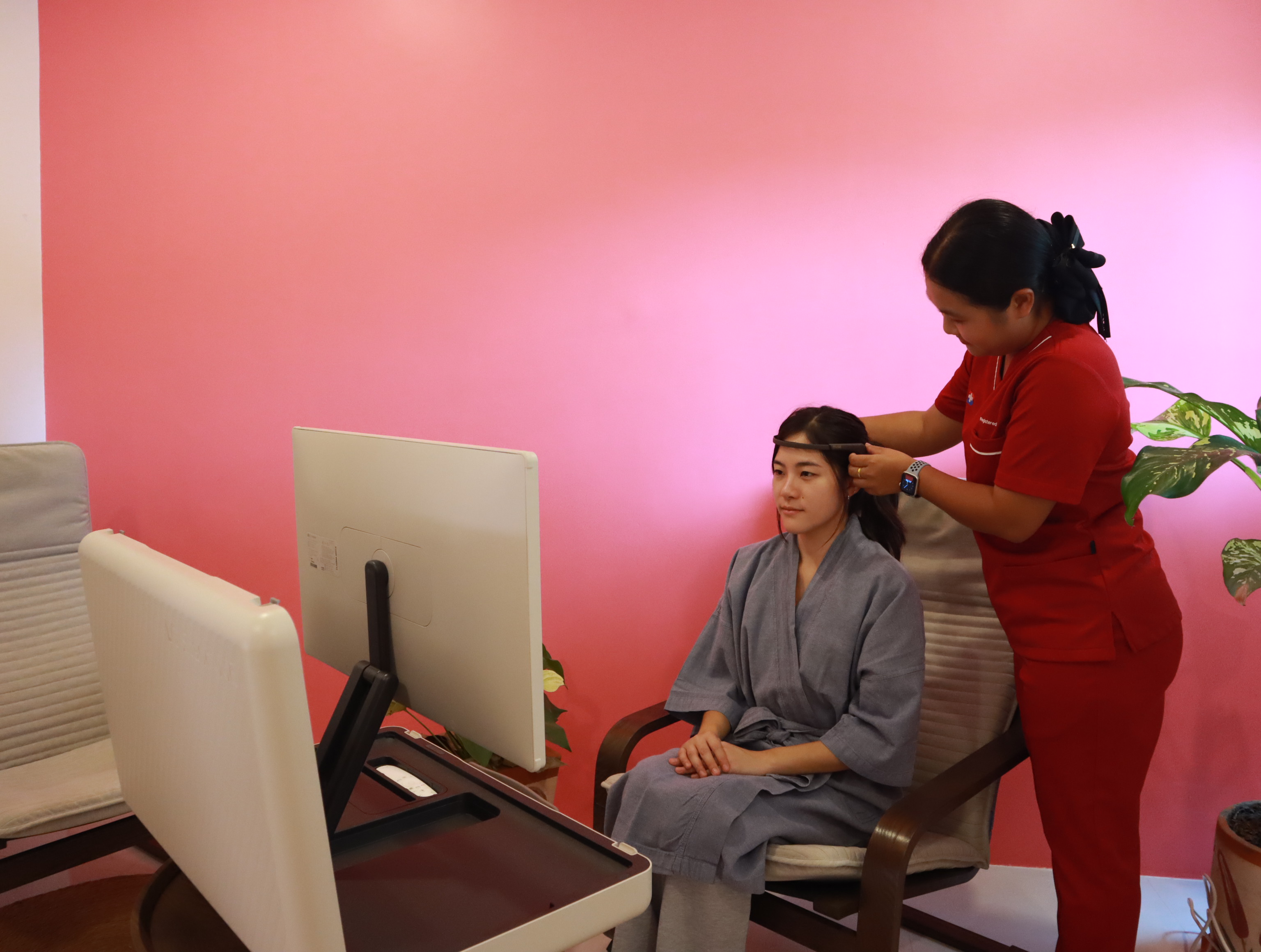
Sensors are placed gently on the fingers, wrists, or scalp depending on the biofeedback modality — typically measuring heart rate variability, skin conductance, breath rate, and muscle tension. You then engage in guided practices while watching your own physiological response in real time. Sessions are calm, focused, and often deeply absorbing. Many clients find them among the most clarifying experiences in their programme — the first time they have had objective evidence of their own nervous system's state.
A single biofeedback session is informative. A sequence of sessions, as part of a residential programme, is transformative. Each session builds on the last, and the practitioner tracks your baseline measurements over time — providing objective evidence of the nervous system shifts that are happening alongside your psychological and somatic work.
Biofeedback is most powerful when it is part of a therapeutic ecosystem rather than a standalone session. At Holina it is woven into the residential programme alongside:
A meta-analysis of 5 studies (95 military service members) found a moderate-to-large overall effect of HRV biofeedback in reducing PTSD symptoms, with notably low attrition rates.
Read the study →A meta-analysis of 14 RCTs (794 participants) found HRV biofeedback produced a medium effect size in improving depressive symptoms across adult samples.
Read the study →The foundational review establishing that a sense of physiological safety is a measurable autonomic nervous system state — the underlying theory behind biofeedback and nervous-system regulation work.
Read the study →Not at all. The sensors are gentle and non-invasive — typically placed on fingers, wrists, or the scalp with conductive gel or soft clips. Sessions are calm and generally experienced as restful or absorbing rather than demanding.
The number of biofeedback sessions is tailored to your programme length and clinical profile. They are scheduled alongside your other therapeutic work so that each session builds on what is happening across your programme. We discuss frequency during your intake assessment.
Yes — this is actually one of the clearest indications for biofeedback. If you have done talk therapy and understand your patterns intellectually but still feel stuck physiologically, biofeedback offers a route that works at the level of the nervous system rather than the narrative. Many clients find it reaches something that years of talking did not.
None at all. Your practitioner explains everything as you go and interprets the data with you. The technology exists to make the work more precise — it is not something you need to understand or operate yourself.
Biofeedback is the broader category — it encompasses any modality that feeds back real-time physiological data, including heart rate, breath, muscle tension, and skin conductance. Neurofeedback is a specific form of biofeedback that focuses on brainwave patterns. At Holina we use the full biofeedback suite, selecting modalities based on your clinical profile.
All enquiries are completely confidential. No obligation. We respond personally.
Begin Your Biofeedback Programme →