The Burnout Retreat: When Rest Alone Isn’t Enough
A burnout retreat is a structured, residential programme for people whose exhaustion has become chronic rather than situational. Unlike a wellness break, it combines clinical assessment, nervous-system recovery and behavioural change in a supervised setting, addressing the underlying causes of burnout rather than offering temporary relaxation.
The emails stopped feeling urgent some time in the spring, though nothing about the workload had changed. A regional operations lead — capable, well-regarded, the person others came to when a project stalled — found herself reading the same message four times without absorbing it. She was sleeping seven hours and waking unrested. She had taken a two-week holiday in February and returned feeling, if anything, worse: the dread had simply been waiting for her at the airport.
By June she was managing rather than working. She arrived early to appear present, closed her laptop with a relief she did not want colleagues to see, and felt a flat, distant irritation toward work she had once found meaningful. When a friend told her she was “just tired,” she nodded, because she had no better word for it either. What she was describing was not tiredness. Rest had stopped working, and she did not know what came after rest.
This is the point at which people begin, quietly, to look for something more structured than a long weekend — and to wonder whether such a thing exists at all.
What Is a Burnout Retreat?
A burnout retreat is a residential programme designed for people whose exhaustion has become chronic and no longer responds to ordinary rest. It provides clinical assessment and structured recovery rather than leisure.
The distinction matters because burnout is a recognised condition, not a mood. The World Health Organization classifies burn-out in its ICD-11 framework as an occupational phenomenon resulting from “chronic workplace stress that has not been successfully managed,” defined across three dimensions: energy depletion or exhaustion, increased mental distance or cynicism toward one’s work, and reduced professional efficacy (WHO, 2019). In our clinical experience, people arrive able to name only the first of those three, having quietly normalised the other two for months. A burnout retreat exists to interrupt that normalisation in a setting built for recovery rather than performance.
How Is a Burnout Retreat Different From a Wellness Break?
A wellness break offers rest and relaxation to someone who is fundamentally well. A burnout retreat offers clinical care to someone whose stress-response system has become dysregulated. The difference is assessment, structure and follow-through.
A pleasant few days away can be genuinely restorative, but it treats fatigue as the problem. Clinical burnout is not simply fatigue; it is a sustained physiological and behavioural pattern that reasserts itself the moment the pressure returns. A burnout retreat begins with understanding why the pattern formed — the working conditions, the habits of over-functioning, the nervous-system load — and then works to change it. Relaxation is a component, not the goal.
Who Is a Burnout Retreat Actually For?
It is for people whose burnout has become persistent, affecting sleep, concentration, motivation and physical health, and for whom time away has repeatedly failed to help. Reaching a point of crisis is not a prerequisite.
The scale of the problem is easy to underestimate. In the American Psychological Association’s 2024 Work in America Survey, 67% of workers reported experiencing at least one outcome associated with workplace burnout in the previous month (APA, 2024). Most of those people are not candidates for residential care. A burnout retreat is appropriate for the smaller group whose symptoms have become entrenched: those still technically functioning at work but doing so at a cost that is no longer sustainable, and those returning from previous breaks to find nothing has changed. Whether the burnout is tied to a specific role, as in job burnout recovery, or to the strain of caring for two generations at once, as we describe in caregiver burnout and the sandwich generation, the deciding factor is chronicity rather than job title.
Why Doesn’t Taking Time Off Fix Burnout?
Because burnout is driven by ongoing conditions and a dysregulated stress response, not by a temporary shortfall of sleep. Returning to an unchanged environment reintroduces the original load within days.
A holiday removes a person from the situation without altering the situation or the patterns they bring to it. The nervous system, having spent months in a state of chronic activation, does not reset simply because the surroundings are quieter. This is why so many people describe the paradox in the vignette above: they rest, they return, and the relief evaporates almost immediately. We explore this more fully in our comparison of a burnout retreat versus a week off, but the short answer is that time is necessary and, on its own, rarely sufficient.
What Happens During a Burnout Retreat
A burnout retreat begins with a clinical assessment, not an itinerary. We look at sleep, physiology, working patterns and behavioural health history before anything is planned, because two people with the same job title can arrive burned out for entirely different reasons. From that assessment we build a structured programme that typically combines nervous-system regulation, one-to-one psychotherapy, movement, sleep restoration and the slow, deliberate work of changing the habits that produced the exhaustion.
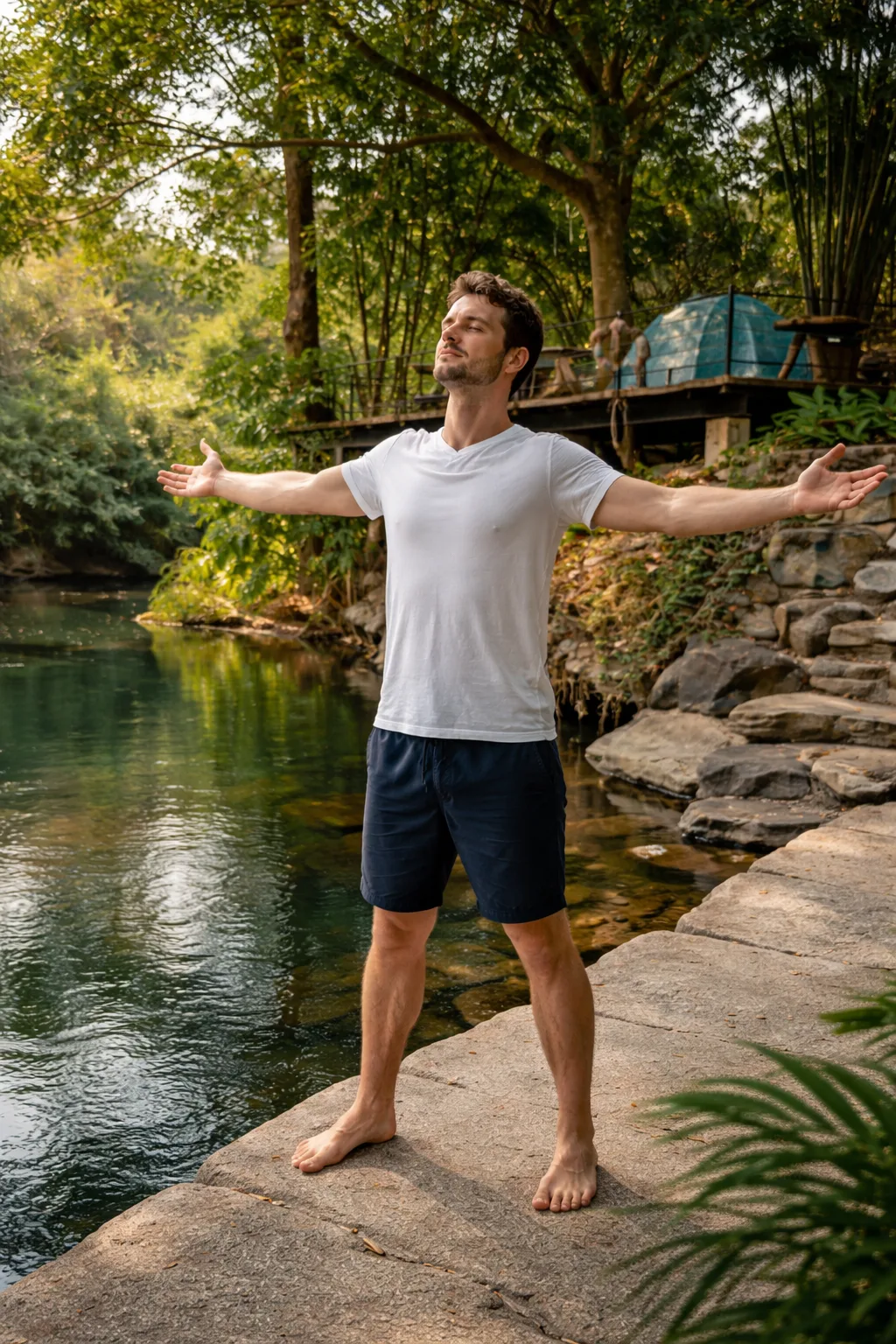
The setting is part of the method. Our programmes take place inland, in the forest and river landscape of Khao Yai, away from the stimulation of the environments most people are recovering from. Much of the early work is physiological, which is why a nervous-system reset retreat often forms the foundation before deeper therapeutic work can hold.
The rhythm is deliberately unhurried. In our clinical experience, people arriving from high-demand roles initially find the pace uncomfortable, because doing less feels like falling behind. That discomfort is itself part of the picture: the inability to be still without anxiety is one of the clearer markers of a nervous system that has been running on activation for too long. Progress tends to begin not when someone is busiest with treatment, but when they first notice they have stopped bracing for the next demand. The clinical team’s role is to hold that structure steady while the body relearns what safety feels like.
“We do not treat burnout by asking people to relax harder. We begin by assessing what the nervous system has been carrying, then rebuild capacity slowly enough that it holds once someone goes home.” — Dr. Natalie Lindemann, Senior Psychotherapist, Holina Global
What Recovery From Burnout Genuinely Requires
Recovery requires more than removal from the source of stress; it requires rebuilding the capacity that chronic stress eroded, and changing what a person returns to. This is unglamorous, often slow work, and it does not proceed in a straight line.
Burnout is not a private failing, and the regional context makes that plain: in a 2024 study across Malaysia, Singapore, the Philippines and Indonesia, 62.91% of full-time working adults reported high or very high levels of burnout (Frontiers in Public Health, 2024). Genuine recovery means addressing the physiology, the behavioural patterns and the conditions someone will re-enter — including, for some, the identity questions that surface once a demanding career ends by choice rather than force, which we explore in identity loss after voluntary retirement. What happens after the programme matters as much as the programme itself, and the structure someone builds around themselves once home is what makes progress hold. For those seeking a longer arc, the the Holina Reset and our 30-day trauma recovery programme allow that work more time to consolidate.
Beginning the Conversation
Most people who reach this point have spent a long time telling themselves they should be able to manage. Deciding to look into structured care is not an admission of weakness; it is a recognition that the strategies that once worked have stopped working. If any of this describes your situation, our admissions team can talk through whether a burnout retreat is the right fit, and you can begin an intake conversation whenever you are ready. Reaching out is not a commitment. It is only the willingness to find out what is available to you.
Frequently Asked Questions
Is a burnout retreat a medical treatment?
A burnout retreat is a clinically supervised recovery programme. Burnout itself is classified by the WHO as an occupational phenomenon rather than a medical diagnosis, but the exhaustion, sleep disruption and behavioural health strain that accompany it are assessed and supported by qualified clinicians.
How long does a burnout retreat last?
Length varies with the severity and duration of the burnout. Shorter reset-focused programmes suit people earlier in the pattern, while more entrenched burnout usually benefits from a longer residential stay that allows physiological and behavioural change to consolidate.
How is burnout different from ordinary stress?
Stress is a response to demand and tends to ease when the demand does. Burnout is what develops when that stress becomes chronic and unmanaged, producing persistent exhaustion, cynicism toward one’s work and reduced effectiveness that no longer lift with rest.
Do I need to have reached a crisis to attend?
No. Many people who attend are still functioning at work but recognise the cost has become unsustainable. Addressing entrenched burnout earlier is generally easier than waiting for a collapse.
Can I attend if I’m still employed?
Yes. Many attendees are currently employed and are recovering while managing their relationship with work. The question of returning to the same role is part of what the programme helps you consider.
How is a burnout retreat different from simply taking annual leave?
Annual leave removes you from the situation without changing the situation or the patterns you bring to it. A burnout retreat combines rest with clinical assessment, nervous-system recovery and behavioural change designed to hold once you return.
Where is Holina Healing located?
Our healing programmes take place inland in Khao Yai, Thailand, in a forest and river landscape chosen deliberately for its distance from the high-stimulation environments most people are recovering from.
What does a typical day involve?
Days are structured but not crowded, typically combining nervous-system regulation, one-to-one psychotherapy, movement, rest and sleep restoration. The specific balance follows the clinical assessment carried out at the start.
Will burnout come back after I go home?
It can, if nothing about the returning environment or the underlying patterns changes. This is why recovery work focuses as much on what happens after the programme as during it, particularly the first thirty days back.
Is recovery from burnout linear?
No. Progress commonly fluctuates, with better and worse periods, which is normal rather than a sign of failure. Understanding this in advance helps people stay with the process.
How do I know if I need a burnout retreat rather than time off?
If you have taken breaks before and returned to find the exhaustion still present, that is a strong indication the burnout has become chronic and may need more structured support than leave alone can provide.
What is the first step?
An initial conversation with our admissions team. It is not a commitment; it is simply a way to understand your situation and whether our approach is a suitable fit.
Clinically reviewed by Dr. Natalie Lindemann — Senior Psychotherapist, Holina Global · Last reviewed 20 July 2026