Why Women Need a Different Kind of Trauma Retreat
Women often carry trauma that has accumulated quietly over years — through caregiving, relationships, careers and loss — rather than a single dramatic event. A trauma retreat designed for women recognises these patterns, offers a female-attuned residential setting, and treats the nervous system and relational wounds together, in privacy, away from the pressures of daily life.
She had not cried in eleven years. She could tell us the exact number because she had counted it against the year her mother was first diagnosed, the year she took over the household accounts, the year she stopped travelling for the job she once loved. By the time she arrived in Khao Yai, she was managing a demanding role, an ageing parent and a marriage that had gone quiet, and she described herself, without irony, as “completely fine.”
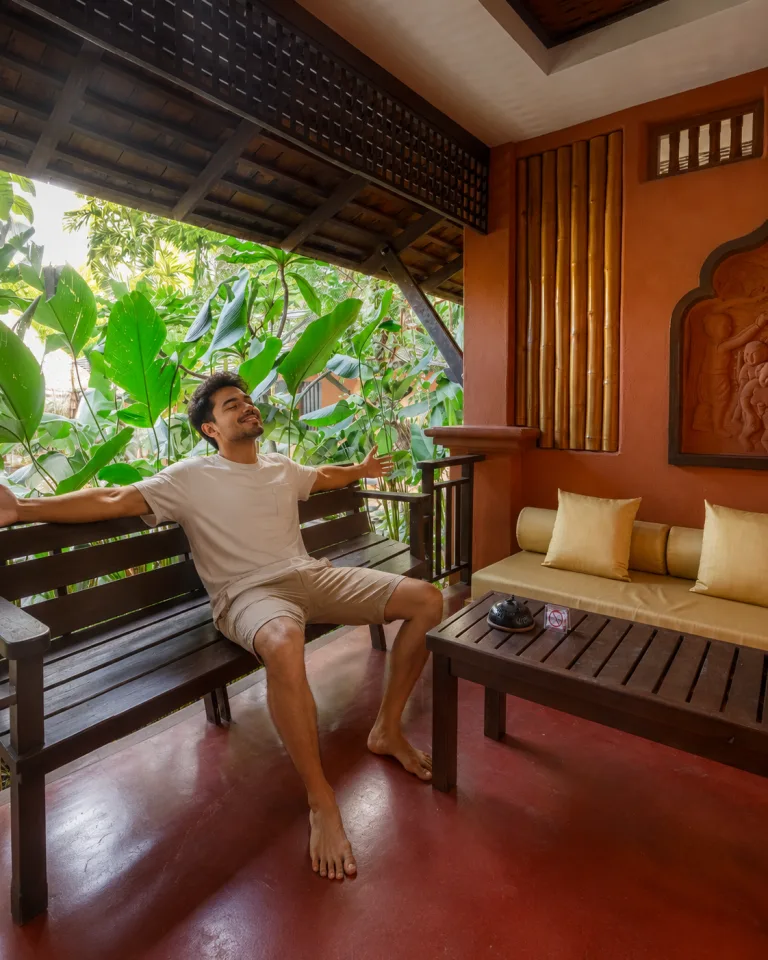
On her second morning, sitting by the river with a cup of tea she had not asked anyone to make for her, she noticed her hands were shaking. Nothing had happened. That was the point. For the first time in over a decade, nothing was being asked of her, and her body finally had room to register how much it had been holding.
In our clinical experience, this is the more common shape of women’s trauma: not a single unbearable moment, but an accumulation of pressures absorbed so gradually that the person carrying them stops noticing the weight. It rarely announces itself as trauma. It arrives disguised as competence. The women who reach us are frequently the ones others describe as capable, dependable, the person who holds everything together — which is precisely why their distress goes unseen for so long, including by themselves.
What makes women’s trauma different from men’s?
The difference is real, and it is measurable. Women develop post-traumatic stress at roughly twice the rate of men. Lifetime prevalence of PTSD is 8.0% for women against 4.1% for men in the large NESARC-III sample, and past-year prevalence among U.S. adults is 5.2% for women compared with 1.8% for men (National Center for PTSD; NIMH). The American Psychological Association places lifetime prevalence at 10–12% for women versus 5–6% for men, noting that women experience PTSD at two to three times the rate men do (APA).
The reason is partly the kind of trauma involved. Women are more likely to endure interpersonal harm — harm inside relationships, homes and families — which tends to be repeated, private and bound up with people they depend on. Globally, about 1 in 3 women (31.6%) have experienced physical or sexual violence by a partner or non-partner in their lifetime (WHO). Beyond violence, women disproportionately carry the cumulative strain of caregiving, betrayal, midlife identity loss and the quiet erosion of a self that has spent years attending to everyone else. This is the invisible weight that our Women’s Trauma Retreat programme is built to address.
Why do standard behavioural health pathways fail women?
Standard pathways are built for the crisis that interrupts a life. Weekly appointments, a symptom checklist, a prescription. This works well for a discrete event. It works poorly for trauma that has been braided into the fabric of a woman’s daily responsibilities, because the pathway asks her to heal without ever setting down the load.
Many women we meet have already tried this route for years. They have a therapist they see between meetings, medication that takes the edge off, and a life that resumes its full demands the moment the session ends. There is no space in which the nervous system can actually stand down. Recovery keeps competing with the school run, the deadline, the parent who needs collecting. In our clinical experience, this is why so many capable women plateau — not because the treatment was wrong, but because it was never given room to work.
What does a trauma retreat for women actually involve?
A residential retreat removes the competition. For a defined period, a woman is not responsible for anyone else. That single change — the absence of demand — is often the first time her body has been safe enough to begin releasing what it has stored.
At Holina Healing, the work is structured rather than passive. Each woman receives an individual clinical assessment and a personalised plan drawn from trauma-focused psychotherapy, somatic and nervous-system approaches, and daily practices that help regulate a body stuck in survival mode. Our inland forest and river setting in Khao Yai matters here: quiet, private and removed from the noise of ordinary life, it gives the nervous system the low-stimulation environment it needs to recalibrate. For women whose trauma is relational, small-group work with other women can be its own form of repair. Men carry comparable strain differently and often reach out later, a distinction we address in trauma recovery built for men.
“Women rarely arrive describing trauma. They arrive exhausted, and convinced the exhaustion is a personal failing,” says Dr. Natalie Lindemann, Senior Psychotherapist at Holina Global. “The first task is often simply to help them recognise that what they have been carrying was never theirs to carry alone. Recognition is where recovery begins.”
What kinds of experience bring women to residential care?
There is no single profile. Some women come after a betrayal that dismantled their sense of safety in a relationship, a pattern we address directly in our betrayal trauma retreat. Others arrive after years of caregiving for a sick or dying family member, having quietly postponed their own needs until there was nothing left. Career-related trauma — sustained pressure, harassment, or a collapse of professional identity — brings others. Midlife brings its own reckoning, as long-suppressed grief and loss finally surface.
Postpartum and pregnancy-related trauma is one thread among these, though it is far from the only one. What unites the women we treat is less the origin of the wound than its trajectory: something has been held for too long, and the body has begun to insist on being heard through sleeplessness, hypervigilance, numbness or a sense of having disappeared inside one’s own life.
What does genuine recovery require?
Genuine recovery requires three things that a weekly appointment cannot easily provide: time, safety and a treatment approach that reaches the body as well as the story. Trauma is not only a memory; it is a physiological state, and a nervous system trained by years of vigilance does not stand down on command. It needs sustained conditions of safety before it will release.
It also requires an environment attuned to how women heal. This means privacy, the option of working alongside other women, and clinicians who understand that self-abandonment — the habit of putting oneself last — is often the injury underneath the injury. Encouragingly, the research suggests women tend to respond particularly well to psychotherapy for trauma once the conditions are right; the obstacle has usually been access to sustained, protected time, not capacity to recover. Recovery is not the removal of a symptom. It is the slow return of a woman to herself, and to a nervous system that no longer treats ordinary life as a threat. For those whose primary struggle is a body locked in overdrive, our nervous system reset retreat offers a more focused starting point.
Is a trauma retreat the right step for you?
If you recognise yourself in any of this — the competence that masks depletion, the sense of having gone quiet inside your own life, the suspicion that “fine” stopped being true some time ago — it may be worth finding out what dedicated care could offer. If you would like to understand your options, our admissions team can talk through what a stay involves, and our trauma healing retreat guide explains the wider approach.
The first conversation is not a commitment. It is only the willingness to find out what is available.
Frequently Asked Questions
What is a trauma retreat for women?
It is a residential programme in which women live on-site for a defined period and receive structured, trauma-focused clinical care in a private, low-stimulation setting, away from daily responsibilities.
How is a women’s trauma retreat different from ordinary therapy?
Weekly therapy asks you to heal while carrying your full daily load. A retreat removes that load for a set period, giving the nervous system sustained safety it rarely gets otherwise, and combines several therapeutic approaches each day rather than one hour a week.
Do I need a formal PTSD diagnosis to attend?
No. Many women who benefit have never been formally diagnosed. What matters is the impact trauma is having on your life, not the presence of a specific label. An individual clinical assessment is part of admission.
Is the retreat women-only?
The Women’s Trauma Retreat programme is designed around female-attuned care, including the option of small-group work with other women. Speak with our admissions team about the current group structure.
What kinds of trauma does the programme address?
Relational and betrayal trauma, caregiving burnout, career-related trauma, midlife identity loss, cumulative long-held stress, and other trauma histories. Care is personalised to each woman rather than to a single category.
Where is Holina Healing located?
In Khao Yai, Thailand — an inland forest and river setting chosen for its quiet, privacy and low-stimulation environment, which supports nervous-system recovery.
How long does a stay last?
Length varies according to individual clinical need and is discussed during your assessment. Our admissions team can talk you through the options.
What does treatment actually involve day to day?
An individual plan drawn from trauma-focused psychotherapy, somatic and nervous-system approaches, and daily regulating practices. Our guide to what happens in a trauma release retreat describes the structure in more detail.
Why are women more affected by trauma than men?
Women develop post-traumatic stress at roughly twice the rate of men, largely because they more often endure interpersonal harm inside relationships and homes, and carry cumulative caregiving and relational strain over years.
Is my privacy protected?
Yes. Confidentiality and discretion are central to how we work, and the setting itself is private and removed from public life.
Can I bring medication I am currently taking?
Yes. Current medication is reviewed as part of your clinical assessment so that care is coordinated safely. Do not stop any prescribed medication without medical guidance.
How do I take the first step?
Contact our admissions team for a confidential conversation about your situation and whether the programme is a good fit. There is no obligation attached to that first conversation.
Clinically reviewed by Dr. Natalie Lindemann — Senior Psychotherapist, Holina Global · Last reviewed 20 July 2026